
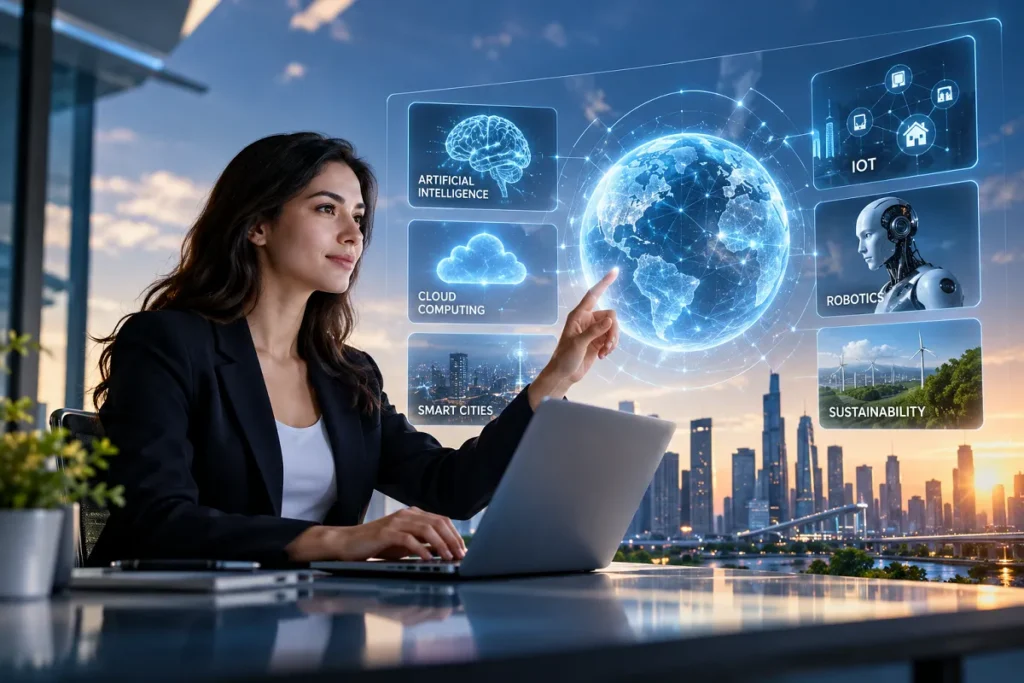
The scope of technology is no longer limited to just using different digital tools; instead, it’s moving towards integrated and advanced systems where artificial intelligence, cloud infrastructure, high-speed networks, cybersecurity, automation, and modern smart devices work together. WTGTechTrends tech trends by WaveTechGlobal highlights this broad technological shift and sheds light on the key technologies that could significantly impact the experiences of businesses, professionals, developers, and everyday users in 2026.
WaveTechGlobal’s current technology coverage particularly focuses on artificial intelligence (AI), distributed systems, cybersecurity, sustainability, and the changing needs of the workforce.
However, the real point isn’t just that new technologies are coming. Businesses also have to figure out which new technology solves real problems, is ready for practical use, and which might create risks that require careful management.
What Is WTGTechTrends Tech Trends by WaveTechGlobal?
WTGTechTrends by WaveTechGlobal refers to WaveTechGlobal highlighting modern and emerging technologies, new tech trends, and their impact on the digital world.
WaveTechGlobal presents itself as a technology-based platform, where the latest tech news, mobile devices, video games, and information about smart home technology are provided. Its special latest technology trends section also publishes articles on key topics like artificial intelligence (AI) tools, edge computing, and digital transformation.
Instead of seeing every new product as a huge change, people can get a better understanding of it by asking three key questions:
- What is the real-world problem being solved by this technology?
- Is the technology reliable and ready for implementation?
- What are the dangers, costs, and competencies involved in implementing this technology properly?
These questions become even more important when we consider the major technology trends of 2026.
1. Artificial Intelligence Is Becoming Part of Everyday Work

Artificial intelligence is still one of the major advancements influencing today’s technology. A big change in 2026 is that AI is no longer limited to just individual chatbots. Companies are using AI models to create software, help customers, improve search, make work easier and faster, analyze data, and even manage their internal business operations.
From Generative AI to Intelligent AI Agents
Generative AI creates various types of content, including text, images, audio, and code. On the other hand, AI agents go a step further by planning different stages to achieve a specific goal and trying to complete the desired task.
For example, instead of just writing an email, an AI-based system can do this:
- Check customer information.
- Develop a personal message.
- Update the customer information in CRM.
- Schedule a follow-up.
- Provide a short summary of the discussion to the sales representative.
This change can make AI more useful, but it also makes it more important to monitor and control what automated systems are permitted to do.
Human Oversight Remains Important for Effective AI Use
Even rapid developments in AI do not mean it will always deliver the right, appropriate output.
As noted in the report from Stanford 2026, the number of cases regarding AI has risen significantly. It becomes evident that businesses require proper testing, control, and supervision while applying AI. In particular, in those situations when it is crucial to have the appropriate outcome, businesses should make sure that the results delivered by AI are validated, data protection is guaranteed, and human supervision remains in place.
2. Cloud Computing Is Expanding
Cloud computing is still very important for today’s modern digital conveniences, but infrastructure is rapidly moving towards more distributed systems.
Traditional cloud systems usually process data and information in large central data centers. In contrast, edge computing brings some tasks and data processing closer to users, machines, and connected devices.
According to WaveTechGlobal’s technology trends report, distributed infrastructure, edge computing, and cloud-native technologies are among the areas expected to be notably important in 2026.
The Importance of Edge Computing
Sending all the information to a remote cloud server can cause unnecessary delays.
For example, it might be really important to immediately detect a safety hazard for an industrial robot. In such a situation, instead of sending the data over the network to a remote server and waiting for a response, processing the data locally can be a faster, simpler, and more practical approach.
Other important uses of edge computing are as follows:
- Automated systems and machines.
- Modern smart factories.
- Connected vehicles.
- Data analysis of shops and markets.
- Augmented reality (adding virtual elements to the real environment).
- Sensors used in industrial operations.
- Advanced infrastructure systems of smart cities.
Cloud and edge computing are thus becoming increasingly complementary technologies rather than competing ones.
3. 5G Is Driving a More Connected Digital Economy

High-speed networks are an important part of today’s modern technology. According to a GSMA report, by 2025, mobile technology and services will contribute around $7.6 trillion to the global economy, which is about 6.4% of the world’s total GDP. GSMA expects this economic impact to grow even more with the increasing use of 5G, artificial intelligence (AI), and other digital technologies. 5G technology isn’t just about faster downloads on smartphones.
Its real importance lies in its ability to support a large number of connected devices at the same time, provide services with low latency, and enable the use of various advanced applications in modern industries.
Possible applications can be in the following fields:
- Networked factories.
- Video analytics in real time.
- Remote surveillance.
- Intelligent transportation systems.
- Internet of Things (riot).
- Mobile gaming and cloud applications.
The interaction of 5G networks, edge computing, and artificial intelligence (AI) should also be paid special attention to, because all three can complement each other’s strengths.
4. Cybersecurity is becoming an essential part of every technology decision

As technology becomes more interconnected, the chances and risks of digital attacks are also increasing. Cloud services, AI-based applications, mobile devices, connected gadgets, and third-party software can all pose different cybersecurity threats. That’s why cybersecurity can no longer be seen as something to be added after a product is finished.
Now, it’s important to consider security right from the design stage, rather than waiting until the final stage of product development.
Artificial intelligence provides new opportunities but also creates several risks
Artificial intelligence (AI) can help security teams analyze a lot of information and spot suspicious or unusual activities. However, if AI systems are not properly controlled and used, it can lead to issues regarding user privacy, data protection, and the reliable performance of the system.
NIST maintains an AI Risk Management Framework that helps organizations identify potential risks from AI and manage them effectively. In 2026, NIST also started the process of developing more guidelines for the use of reliable AI in critical infrastructure .
Organizations implementing AI should therefore consider:
- Principles of data access.
- Model verification.
- Privacy requirements.
- Dependence on external organizations or parties.
- User identity verification.
- Continuous monitoring.
- Procedures for handling emergencies.
The key takeaway from WTGTechTrends tech trends by WaveTechGlobal is that technological innovation and security must progress hand in hand.
Sustainable computing is becoming increasingly important
Modern technologies need a powerful infrastructure. AI models, cloud computing, and applications that work with vast amounts of information operate on servers that consume power, need cooling, and are supported by huge computer centers. The growth in digital demands and the increasing use of technologies cause companies to focus on improving the efficiency and speed of software and hardware.
The following steps can be included in sustainable technology:
- Data centers that use less electricity.
- Advanced AI models that use fewer resources.
- Efficient and proper use of hardware.
- Reducing the storage of unnecessary data.
- Using electronic devices for a longer time.
- Organizing tasks smartly.
- Using renewable energy sources.
The goal is not just to reduce the use of technology, but to achieve more efficient computing while using as few unnecessary resources as possible.
That’s why performance and effective use of resources are becoming increasingly important every day, both for environmental protection and financially.
Smart Devices Are Getting Smarter
Technology has enabled the interconnection of cameras, temperature regulators, cars, household machines, sensors used in industry, and wearables, among others. The next step in the development of IoT would be making the devices understand the data being provided to them, and taking actions according to that. For instance, instead of just capturing video feed, the security cameras could understand anything out of place. Likewise, an industrial machine could identify any vibration before breaking down.
These systems bring together several trends at once.
Sensors → connectivity → edge computing → AI analysis → automated action
This interaction helps us understand that different technology trends shouldn’t always be seen as separate from each other.
Technology Skills Are Adapting to New Tools

Improvements in technology not only have an effect on the machinery but also affect the people and employees directly. Organizations using AI and cloud technology require employees who are able to comprehend business challenges, make proper and responsible use of technology, and verify the accuracy of their outcomes.
The technology reports of WaveTechGlobal focus especially on training the employees and educating them with new skills in order to manage AI monitoring and cloud technology properly.
Essential technology skills increasingly include:
- AI knowledge and literacy.
- Cybersecurity understanding.
- Cloud technologies.
- Data analytics.
- Process automation.
- Prompt and workflow development.
- Analytical and critical thinking.
- Data privacy and governance.
- Effective communication between technical and business teams.
Employees do not necessarily have to become AI engineers. However, many professionals can benefit from learning how AI-powered tools influence and support their particular areas of work.
How Companies Should Evaluate New Technology Trends
Keeping up with every technology trend can lead to unnecessary spending.
A more effective approach is to align technology decisions with specific, measurable problems.
Step 1. Determine the Problem
Start off with a proper business problem rather than going after the latest technology fad.
For instance:
- Response times for customer service are taking too long.
- Is more significant than.
- We should get an AI chatbot since AI is the current trend.
Step 2: Try a Small Use Case
Before changing the whole system, start a pilot project on a small scale.
For example, if a company is thinking about using AI to provide customer support, it can first use it just to search for information within the company. After that, if it works well, it can also be used to answer customers’ questions.
Step 3: Review Results
Useful measurement methods may include the following:
- Reducing the time taken for work.
- Cost per task.
- Customer happiness and satisfaction.
- Number of errors.
- System response speed.
- Employee performance and productivity.
- Amount of energy used.
Step 4: Assess Risks
Organizations should evaluate security, privacy, reliability, regulatory compliance, and reliance on vendors before expanding their deployment.
Step 5: Expand What Works Best
A technology deserves broader adoption when evidence demonstrates that it delivers significant value, rather than simply because it is innovative or new.
How Major Technology Trends Are Connected
The most important takeaway from the world of technology in 2026 is that different technological advancements are now connecting with each other more strongly.
Effectively running artificial intelligence (AI) requires advanced computing infrastructure.
Cloud infrastructure is now rapidly linking up with edge technology and edge systems.
Edge systems are becoming more useful and efficient with faster and better internet connectivity.
As more devices and systems connect with each other, the need for robust cybersecurity is also growing.
The increased use of computing and digital technology is also drawing more attention to energy-efficient and cost-effective usage.
To successfully utilize all these technologies, we need people who have the right digital and technical skills.
Understanding this interconnection helps WTGTechTrends and WaveTechGlobal better understand technology trends, rather than looking at AI, cloud, mobile technology, and cybersecurity as separate topics.
What Should Readers Read Next?
The technologies that currently get more attention and importance might not necessarily bring the greatest gains in the future.
Readers should take into account the technologies that are really adopted and implemented.
The key components are cost-saving, efficiency and reliability, well-defined regulation, coordination of the various systems, and tangible results of the application of the technology.
AI might be important in the upcoming years since the progress in this sphere can have a considerable influence on many spheres such as software engineering, cybersecurity, health care, education, science, robotics, and productivity at work.
Nevertheless, companies need to remember that fast technological advances will not necessarily address the problems connected with security and accuracy of information.
Final Thoughts
WTGTechTrends is the presentation of the latest technology trends in an age when AI, cloud computing, edge technology, 5G, cyber security, smart devices, and green computing technologies are increasingly connecting with one another. While it is currently fashionable to talk about artificial intelligence, it is when different technologies are combined into a system that helps solve some issues in the real world that transformation occurs.
What is more reasonable for companies is first to identify what they need and what problems they have instead of implementing all emerging technologies immediately. Next, one should implement the proper technology on a trial basis, analyze the result, and then implement the technology on a broader scale only if some positive effect was identified. The same applies to average users, who should know how different technologies are working together instead of knowing only the names of different products and applications.
Frequently Asked Questions
What is WTGTechTrends tech trends by WaveTechGlobal?
It refers to WaveTechGlobal’s coverage of major technological advancements, including artificial intelligence, cloud and edge computing, cyber security, connectivity, and digital transformation.
What is the most significant technology trend in 2026?
Artificial intelligence is one of the most important technological trends, as it is becoming increasingly integrated into software, business operations, data analysis, and automation.
Why Edge Computing Matters?
Edge computing handles some data closer to its source, which can decrease delays and enhance performance for connected devices and real-time applications.
How does 5G work alongside other emerging technologies?
5G enables higher-speed connectivity and supports a greater number of connected devices, working alongside technologies like edge computing, AI, and mobile apps.
Should businesses embrace every emerging technology trend?
No. Businesses should identify genuine problems, test appropriate technologies, measure their outcomes, assess potential risks, and expand their use only when they deliver clear benefits.
For more informational articles, please visit: Creative Blog Feeds